


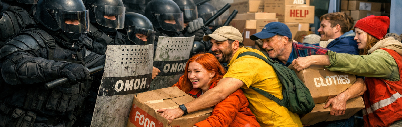
Belarusian security services criminalize humanitarian aid, targeting volunteers supporting refugees across Lithuania, Poland, and Latvia.
The humanitarian activities of the Belarusian human rights organisation in exile “Our House”, carried out jointly with IGFM / Arbeitsgruppe Wittlich (Germany), have been officially labeled as extremist by the Republic of Belarus, despite the fact that this assistance is provided to refugees from Belarus, Ukraine and Russia outside the territory of Belarus – in Lithuania, Poland and Latvia.
In total, 20 humanitarian trucks, each carrying approximately 15 tonnes of essential humanitarian supplies, have been delivered.
These humanitarian convoys have consistently attracted unhealthy attention, increased surveillance and direct attacks from the security services of the Belarusian regime.
Humanitarian assistance to refugees from Belarus, Russia and Ukraine is under such severe attack precisely because it gives people hope and faith – faith that we remain human; hope for humanism, for kindness, for reconciliation, and ultimately for change. It restores a person’s sense of dignity, inner strength, and the energy not to give up, to keep living, to keep helping others, and to keep resisting.
It is this very capacity of humanitarian aid to strengthen human resilience and to break the logic of fear that makes it unacceptable to authoritarian power. Because hope – and the belief that together we can overcome what is unjust and destructive – is something that cannot be controlled. And it is precisely this hope that deprives dictatorship of its most important weapon: people’s loss of faith in the power of solidarity.
State Propaganda and Public Targeting
On 11 May 2023, the main state newspaper of Alexander Lukashenko’s regime, “Belarus Segodnya” (formerly Sovetskaya Belorussiya, the Belarusian analogue of the Russian propaganda outlet Russia Today), published a separate article specifically devoted to these humanitarian deliveries and, in practice, issued threats against “Our House” as an organisation.
This public attention from an official propaganda organ effectively placed all volunteers of “Our House” who participate in receiving and unloading humanitarian aid under special scrutiny by Belarusian security services, significantly increasing the risks to their personal safety.

Accusation of Espionage
On 2 October 2022, one of the largest Belarusian propaganda Telegram channels, “Zhyoltye Slivy” (Yellow Plums or Yellow Leaks), publicly declared Olga Karach, Director of the Belarusian human rights organisation “Our House,” to be an “agent of Polish intelligence.”
The sole basis for this so-called “exposé” was that “Our House,” together with the German human rights organisation IGFM, had delivered a humanitarian truck to Kraków, Poland. In total, IGFM, through “Our House,” delivered two humanitarian trucks to Poland, amounting to more than 30 tonnes of humanitarian aid for Belarusian and Ukrainian refugees.
“Zhyoltye Slivy” is one of the largest propaganda channels of the Belarusian regime, used to disseminate disinformation and fabricated accusations against Belarusians who participated in protests. The channel also distributes falsified narratives and so-called “repentance videos” of detained Belarusians filmed in front of the door of GUBOPiK and the letter “Z,” with visible traces of torture and signs of brutal treatment. In these videos, terrified individuals are forced to apologise to Alexander Lukashenko for having “participated in protests.”

Targeting of the 20th Humanitarian Convoy
On 30 November 2025, after the arrival and unloading of the 20th humanitarian truck in Vilnius, a video of the unloading was republished by the Telegram channel “Kniga GU ‘BAZA’”
The video was accompanied by a mocking and hostile narrative portraying humanitarian activity as unlawful and criminal. Belarusian security officers expressed envious comments about the humanitarian convoy, while deliberately removing the logos of the German and Belarusian organisations from the publication in order not to enhance their reputation among pro-regime security circles.

What GUBAZ / GUBAS Means
This Telegram channel is associated with GUBAZ (or GUBAS) – the informal designation of the Main Directorate for Combating Organised Crime and Corruption of the Ministry of Internal Affairs of the Republic of Belarus.
This unit is widely known for the systematic use of torture against activists, journalists and human rights defenders, for cruel and degrading treatment, and for the production of forced “repentance videos,” in which detainees, bearing visible traces of violence, are compelled to publicly “repent” and apologise to Alexander Lukashenko for their civic, journalistic or political activities. These videos are used as instruments of psychological intimidation against activists and volunteers of “Our House.”
Repressive Function of These Publications
Such publications serve not an informational but a repressive function. They publicly identify volunteers, document their participation in humanitarian activities, and effectively register them within the field of attention of structures connected to Belarusian law-enforcement agencies.
As a result, these publications significantly increase the personalised risk of criminal prosecution for each volunteer, coordinator and participant involved in humanitarian aid.
In practice, humanitarian assistance to refugees has been transformed by the Belarusian regime into a pretext for surveillance, intimidation and future criminal repression.
What “Extremism” Means in Practice for Volunteers of “Our House”
Under Belarusian law, participation in an “extremist formation,” dissemination of so-called extremist materials, or any form of cooperation with such structures is punishable by sanctions ranging from up to 15 days of administrative detention to long-term imprisonment of up to seven years.
As a result, volunteers, coordinators, participants in unloading humanitarian trucks, administrators of humanitarian chats, volunteers sorting humanitarian aid, and even people who publicly express support for the humanitarian work of “Our House” on social media are automatically placed in the zone of criminal risk.
In practice, humanitarian assistance to refugees from Belarus, Ukraine and Russia, provided in Lithuania, Poland and Latvia, is treated in Belarus as a serious criminal offence.
Sequence of Repressive Decisions
Repression against the humanitarian activities of “Our House” and its support for Belarusian conscientious objectors developed in a systematic and step-by-step manner:
-
4 May 2022 – The Ministry of Internal Affairs of the Republic of Belarus designated “Our House” as an extremist formation.
-
8 August 2024 – The Ministry of Information added the official Facebook page “Our House. Help for Belarusians and Ukrainians” to the list of extremist materials.
-
May 2024 – The Baranovichi District Court declared the Telegram channel “Our House-Shuflyadka” extremist. The channel was dedicated exclusively to humanitarian activities, coordination of truck unloading, and fair and transparent distribution of aid, and united around 600 volunteers. All participants of this chat were thus equated with members of an “extremist association,” exposing each of them to a potential sentence of up to seven years in prison in Belarus.
-
21 March 2025 – By court decision, Olga Karach’s personal Facebook account was included in the Republican List of Extremist Materials.
Each of these decisions concerned not political agitation, but humanitarian communication and the defence of Belarusians’ right to refuse military service on grounds of conscience.
Personal Risks for Volunteers
The most vulnerable group within the humanitarian work of “Our House” are Belarusian volunteers who mostly reside in Lithuania without stable legal status, often without documents, under constant threat of detention and deportation to Belarus.
These people live in a state of legal insecurity and face the daily risk of being sent back to a Belarusian prison. At the same time, Lithuanian state authorities make significant efforts to deport Belarusian political refugees despite the evident risks of torture, imprisonment and political persecution. In this context, Lithuania effectively acts not as a country of protection, but as a hybrid ally of Alexander Lukashenko’s regime, attempting to return political refugees, activists and human rights defenders into the system of repression.
For these Belarusian volunteers, participation in the humanitarian work of “Our House” has not an abstract, but a direct criminal price. If deported to Belarus, they will inevitably end up in prison, where they face interrogations, brutal treatment, torture and so-called “repentance videos” filmed at the doors of GUBOPiK (“GUBAZ” / “GUBAS”) – a unit notorious for systematic violence and forced public humiliation.
Each such volunteer fully understands: humanitarian activity in Lithuania today may tomorrow personally turn into a long prison sentence in Belarus.
Why Volunteers Remain Despite Everything
Despite these risks, volunteers do not leave.
They understand the consequences. They are afraid. They cry. They suffer panic attacks, depression and emotional breakdowns. They are often forced into silence. Yet they remain with “Our House.”
It is precisely through its humanitarian work that “Our House” has built a special reputation among ordinary Belarusians, Ukrainians and Russians. For thousands of people, the organisation became not a human-rights brand, but a real point of rescue in moments of acute life crisis – loss of home, security, documents and future.
That is why people continue to volunteer and help other refugees with all the strength they have, despite pressure, threats and fear. They stay because, in the hardest moment of their lives, they received not only food, clothing or help with documents, but human respect, dignity, and the feeling that they were not abandoned and not alone.
The Meaning of This Confrontation
This is the confrontation that exists today in Lithuania and Belarus: between a system of fear and human solidarity.
And this is why the humanitarian work of “Our House” together with IGFM / Arbeitsgruppe Wittlich (Germany) remains alive – despite repression, threats of deportation, criminal risks and propaganda attacks from all sides.
Acknowledgement
We thank IGFM / Arbeitsgruppe Wittlich (Germany) for standing alongside us through all these years and for helping people in the most difficult moments of their lives.

Related articles:
 Our House and IGFM: humanitarian aid to Belarusian and Ukrainian refugees in Lithuania
 Our House and IGFM continue joint efforts to provide humanitarian aid to Belarusian and Ukrainian refugees in Lithuania
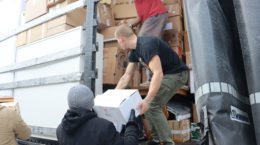 Humanitarian aid from IGFM for Belarusian and Ukrainian refugees delivered to Vilnius
 30 Ukrainian refugees received humanitarian aid from Our House
 A Truck Full of Hope: IGFM-Wittlich Sends Humanitarian Aid to “Our House” in Lithuania for Belarusian and Ukrainian Refugees
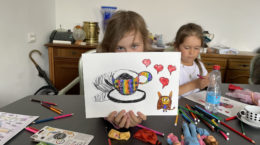 Women’s self-help: free hobby clubs in Our House for Ukrainian and Belarusian children refugees in Lithuania.